Blog
Maj Hartmann | Politics in Publishing
13th August, 2024 in Author’s corner

Maj Hartmann is a postdoctoral researcher in political history in the Japanese Studies Research Group of the KU Leuven Faculty of Arts.
Japan’s role in the globalization of intellectual property rights was not solely determined by the state. Instead, it was shaped by the interests of specific occupational groups and a complex interaction between business, academia, and the state, with all involved actors closely interconnected.
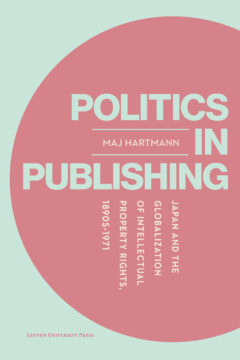
In her book Politics in Publishing Maj Hartmann focuses on Japan’s involvement in shaping international copyright law over a seventy-year period following the country’s 1899 accession to the Berne Convention, the first multilateral copyright treaty. During this time, Japanese state officials collaborated with various stakeholders such as publishers, translators, and legal experts to strategically influence the international revision process of the treaty. “The story of international copyright has often been told from a European perspective.”, explains Hartmann.
Briefly and concisely explain in plain language what the book is about.
This book explores the global history of copyright by examining Japan’s pivotal role in shaping international copyright law from the late 19th century to 1971. In 1899, Japan joined the Berne Convention, an international agreement set up by mostly European countries to protect the rights of authors and artists. While the story of international copyright has often been told from a European perspective, this book shifts the focus to Japan. Unlike other accounts that center on states, this book reveals how Japan’s publishers, translators, authors, and legal experts played a crucial role in shaping the country’s approach to copyright. These groups worked together, using petitions and advisory councils to influence both Japanese officials and international organizations like the League of Nations and UNESCO in the international copyright negotiations.
By looking at the international meetings and discussions that shaped modern international copyright law, my book uncovers the complex network of people and ideas behind Japan’s involvement in the global copyright system. It offers new insights into how national and international policies are formed and how they impact legal standards worldwide.
What or who inspired you to choose this topic?
I have always been interested in forms of international cooperation. During my BA studies in Television Production at Southampton Solent University in the UK, I spent a summer working in the Documentary Coproductions Department of German television channel ZDF, where I was particularly fascinated by the challenges of producing programs suitable for both the East Asian and European markets. After receiving an MA in East Asian Studies in 2015, I briefly worked in the Foreign Rights Department of the German publishing company arsEdition GmbH, which specializes in children’s books, where I was responsible for the Japanese market. During my time at arsEdition, I also attended the Frankfurt Book Fair—which was first attended by Japanese publishers in 1963—where I had the opportunity to speak with various publishers from Japan. It was during these discussions that I realized how little is known about the involvement of Japanese publishers in global publishing history, let alone about their historic role in shaping the legal norms we know today. With the initial support of a Starting Grant belonging to Prof. Jan Schmidt, head of the Japanese Studies Research Group at KU Leuven, I began my PhD at KU Leuven in 2016 and received a Fellowship of the Research Foundation Flanders (FWO) that same year (original working title: “Politics in Publishing — The Internationalization of the Japanese Book Market: Publishers, Business Organizations, and the State, 1900-1960”).
Do you have any reading suggestions to share (books, blogs, journals, …) for anyone who wants to know more about the subject?
There are numerous influential works that have shaped my research and writing process. For those interested in the globalization process of intellectual property rights and the history of the relevant institutions, I highly recommend Isabella Löhr’s Die Globalisierung geistiger Eigentumsrechte (The Globalization of Intellectual Property Rights), which I often referred to. She has also published articles on the topic in English. To explore the history of Japan’s early publishing industry, Peter Kornicki’s classic The Book in Japan was an invaluable resource that I revisited frequently. Additionally, for insights into state-society relations, Sheldon Garon’s works, particularly Molding Japanese Minds, had a significant impact on my research and approach.
How did the writing process for this book go? Did you experience anything surprising, amusing or strange?
With the support of FWO, I was able to spend several fieldwork stays in Japan during the writing process of this book. During these research stays that I spent at Keiō University, Sophia University and Kōbe University, I collected and copied source material and also built valuable contacts. I ended up writing a large part of my book on top of Mount Rokkō in Kōbe where I lived during one of my fieldwork stays and regularly ran into wild boar (inoshishi in Japanese) on the university campus.
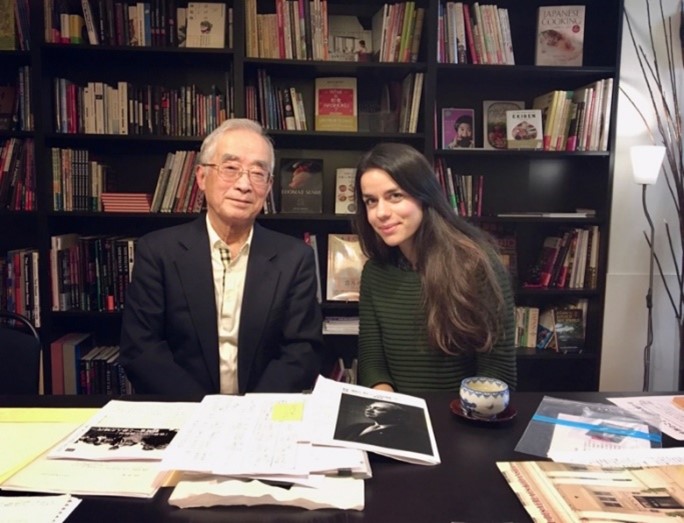
A memorable part of the writing process was the oral history interview I conducted with Ichihara Tokurō, who was 87 years old at the time. He is the former secretary of publisher Noma Shōichi, the key figure involved in UNESCO and the postwar international copyright negotiations. I met Mr. Ichihara over tea in Tokyo’s book district Jinbōchō to hear him speak about the early postwar period. Hearing first-hand from someone who lived through the era I had spent so many hours researching and reading about was an invaluable experience.
What would you like readers to remember about your book?
I want readers to challenge the Eurocentrism that persists in many written works and to reconsider the often-assumed central role of the state in shaping the modern international legal system.
Additionally, I hope readers will recognize that Japan’s integration into the international copyright system—and more broadly into today’s liberal international order—was neither smooth nor linear. It was marked by significant disagreements and areas of friction. At times, Japan’s involvement led to a complete stagnation of the international copyright community’s efforts to globally unify copyright. In other instances, Japan acted as a promoter and catalyst for advancing the ideas behind the Berne Convention. These insights are crucial because they reveal that Japan’s role in the globalization of intellectual property rights was not solely determined by the state. Instead, it was shaped by the interests of specific occupational groups and a complex interaction between business, academia, and the state, with all involved actors closely interconnected.
Your book is published open access thanks to the partial support of the KU Leuven Fund for Fair Open Access. How did the open access publication process go? What makes open access so attractive for you/your book? Have you thus far noticed that your book reaches a wider audience?
The application process was straightforward. With the support of Leuven University Press and my supervisor, Jan Schmidt, I submitted an application to KU Leuven and received positive feedback in less than two months.
I am thrilled that my book, which engages with the early discourse on Open Access, is being published Open Access. The ease of access and the ability to download the book freely will significantly boost its visibility. I hope this will inspire others to adopt a similar non-Western perspective on the history of international organizations and global governance. Additionally, the OA publication allows me to incorporate parts of the book into my MA seminar on “Transnational and Global Perspectives on East Asia” without imposing any additional financial burden on my students.
Do you have any plans yet for another publication? What will it be about? Would you consider publishing the book open access?
I am currently working on my second book which explores the transnational history of data protection and privacy in Japan. My new project investigates the role of so-called ‘privacy advocates’ within the politics of Japan’s personal information laws between the 1960s and early 2000s as part of global history. It focuses on these actors as integral to a new transnational social movement since the 1960s and on their involvement in shaping not only the national policy process but also the international framework in the making of global digital governance. I would definitely like to publish my new book Open Access as well.