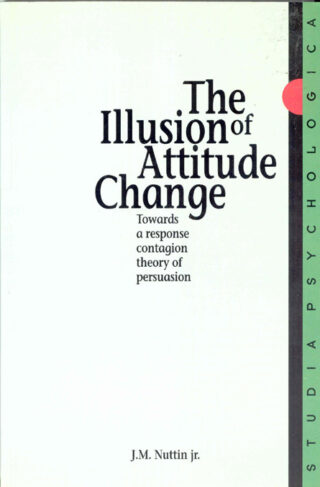
The Illusion of Attitude Change
Towards a Response Contagion Theory of Persuasion
Jef Nuttin (Author),
In the present monograph some thirteen unpublished experiments are reported which represent the core of a long term research project on attitude change undertaken by the author in close collaboration with Dr. Annie Beckers at the Laboratorium voor Experimentele Sociale Psychologie of the University of Leuven. The starting point of this programme has to be situated in Leon Festinger’s 1957 book in which a challenging theory on cognitive integration and change is offered as a common conceptual framework for the understanding of an impressive amount and wide variety of psychological phenomena. The four main classes of research problems which were covered in the original publication are: the consequences of decisions, the effects of forced compliance, the voluntary and involuntary exposure to information and the role of social support.
Foreword by J.T. Lanzetta
Preface and Acknowledgements
1. The Cohen-Rosenberg Controversy and our 1964 Research
1. Festinger’s cognitive dissonance theory and the campus-riot experiment of Cohen
2. Rosenberg’s “When dissonance fails”
3. Our 1964 critical replication of Rosenberg’s experiment
4. Inconclusive evidence about the cognitive dissonance effect
Conclusion
2. An Experimental Challenge of the Interpretation of a Cognitive Dessonance Effect
1. Some common procedural features of our 1969 research
2. Experiment Five: The effect of anonymity of public counterattitudinal
3. Experiment Six: The effect of monetary reward for public counterattitudinal advocacy
4. Experiment Seven: “Dissonant” reward and counterattitudinal nature of anonymous public advocacy
5. Experiment Eight: “Dissonant” reward and public or private nature of the counterattitudinal advocacy
Conclusion
3. Evidence for an A-Cognitive “Dissonant” View
1. Experiment Nine: The effect of a “dissonant” but highly appreciated non-monetary reward
2. Experiment Ten: The effect of a “dissonant” aversive stimulus
3. Experiment Eleven: “Dissonant” stimuli and attitude change after pro- and counterattitudinal, persuasive and non-persuasive evaluative verbal responses
4. The Illusion of Post-advocacy Attitude Change: An Evaluative Response Contagion View of Persuasion
1. Enduring attitude change versus stability of a changed attitude response
2. Social attitudes: a mere evaluative response view
3. Dominant “situation-free” evaluative responses and “unpredicted” response change in a precipitating situation
4. Perturbation and evaluative response contagion: rudiments for a theory of persuasion
5. A response contagion reinterpretation of some representative persuasion experiments
Conclusion
References
Appendix to chapter one
Author Index
Subject Index
Frequently Asked Questions
What is "The Illusion of Attitude Change" about?
In the present monograph some thirteen unpublished experiments are reported which represent the core of a long term research project on attitude change undertaken by the author in close collaboration with Dr. Annie Beckers at the Laboratorium voor Experimentele Sociale Psychologie of the University of Leuven. The starting point of this programme has to be situated in Leon Festinger's 1957 book in which a challenging theory on cognitive integration and change is offered as a common conceptual framework for the understanding of an impressive amount and wide variety of psychological phenomena. The four main classes of research problems which were covered in the original publication are: the consequences of decisions, the effects of forced compliance, the voluntary and involuntary exposure to information and the role of social support.
Who wrote "The Illusion of Attitude Change"?
"The Illusion of Attitude Change" was written by Jef Nuttin.
Is "The Illusion of Attitude Change" part of a series?
Yes, "The Illusion of Attitude Change" is part of the "Studia Psychologica" series. It's book 32 in the series.
What is the Table of Contents for "The Illusion of Attitude Change"?
Foreword by J.T. Lanzetta
Preface and Acknowledgements
1. The Cohen-Rosenberg Controversy and our 1964 Research
1. Festinger's cognitive dissonance theory and the campus-riot experiment of Cohen
2. Rosenberg's "When dissonance fails"
3. Our 1964 critical replication of Rosenberg's experiment
4. Inconclusive evidence about the cognitive dissonance effect
Conclusion
2. An Experimental Challenge of the Interpretation of a Cognitive Dessonance Effect
1. Some common procedural features of our 1969 research
2. Experiment Five: The effect of anonymity of public counterattitudinal
3. Experiment Six: The effect of monetary reward for public counterattitudinal advocacy
4. Experiment Seven: "Dissonant" reward and counterattitudinal nature of anonymous public advocacy
5. Experiment Eight: "Dissonant" reward and public or private nature of the counterattitudinal advocacy
Conclusion
3. Evidence for an A-Cognitive "Dissonant" View
1. Experiment Nine: The effect of a "dissonant" but highly appreciated non-monetary reward
2. Experiment Ten: The effect of a "dissonant" aversive stimulus
3. Experiment Eleven: "Dissonant" stimuli and attitude change after pro- and counterattitudinal, persuasive and non-persuasive evaluative verbal responses
4. The Illusion of Post-advocacy Attitude Change: An Evaluative Response Contagion View of Persuasion
1. Enduring attitude change versus stability of a changed attitude response
2. Social attitudes: a mere evaluative response view
3. Dominant "situation-free" evaluative responses and "unpredicted" response change in a precipitating situation
4. Perturbation and evaluative response contagion: rudiments for a theory of persuasion
5. A response contagion reinterpretation of some representative persuasion experiments
Conclusion
References
Appendix to chapter one
Author Index
Subject Index
Related titles
 The Open Handbook of Experience Sampling Methodology – Third edition
Inez Myin-Germeys (Editor), Peter Kuppens (Editor),
April 2026

 Violence and Trauma in Contemporary Performance
Sofie de Smet (Editor), Marieke Breyne (Editor), Pedzisai Maedza (Editor), Christel Stalpaert (Editor),
May 2025
 Musiceren is topsport
Bert De Cuyper (Author), Griet Baert (Author), Linde Verjans (Author),
December 2021



 Ontwikkeling en levensloop
D. Hutsebaut (Author), Karine Verschueren (Author), Luc Goossens (Author),
October 2004
 Wijsheid in gesprekstherapie – paperback
Mia Leijssen (Author), Nele Stinckens (Author),
January 2004
 Schreber revisité
Daniël Devreese (Author), Zvi Lothane (Author), Jacques Schotte (Editor),
December 1998