

Blog
Monica Bravo & Carolin Görgen | Ecologies of Photography in the American West
31st July, 2026 in Author’s corner

Monica Bravo is Assistant Professor of the History and Theory of Photography in the Department of Art and Archaeology at Princeton University. Carolin Görgen is Associate Professor of American Studies at Sorbonne Université and a junior member of the Institut Universitaire de France.
Understanding photography’s ecological entanglements can help us imagine more responsible ways of engaging with the environment today.
Monica Bravo & Carolin Görgen examine the role of photography in documenting, exploiting, and transforming ecosystems across the varied geographies of the American West. In Ecologies of Photography in the American West, they bring together scholars and artists to explore photography’s roots in the earth and its entanglement with resource extraction and ecological rights. The editors share more about the book in this Q&A.
Briefly and concisely explain in plain language what the book is about.
Photography has been closely connected to the American West for a long time. From the early days of photography in the mid-nineteenth century, famous photographs of Western landscapes—such as Carleton Watkins’s images of Yosemite—have been seen as celebrating and protecting nature. This book questions that idea by exploring how photography has not only documented the American West, but also shaped its ecosystems, at times contributing to environmental damage and the use of natural resources for profit. Bringing together scholars and artists, the book looks at how photography is connected to the land itself, including issues of mining, resource extraction, and environmental justice. By rethinking the history of photography in the American West, the book shows both the medium’s role in environmental problems and its ability to inspire new ways of understanding and caring for our ecosystems. It is intended for anyone interested in the important environmental issues facing the American West today.
What or who inspired you to choose this topic?
For the past decade, we have both conducted extensive research in archives of Western American photography. Although we were working on very different topics, ranging from transnational economies of Western American photography in the nineteenth century to amateur photography in the twentieth century, we were both struck by the roots of the medium in the landscapes of the American West. The growing field of eco-critical art history, which pushes beyond representations of the land to instead probe artworks’ interconnections with the environment, has inspired both of our intellectual journeys. The book started as a two-day conference at the Huntington Library, Art Museum, and Botanical Gardens in San Marino, California, which is an institution that houses tens of thousands of photographs related to the environmental histories of the region and thus a perfect gathering place to have these important discussions.
What social impact do you think the book can have, or would you like it to have?
We hope this book encourages readers to see photography not simply as a way of documenting the landscapes of the American West, but as a medium that has actively shaped its histories and continues to do so. By bringing together perspectives from historians and artists, the book invites more critical conversations about the relationship between visual culture and the environment. We also hope it inspires researchers, museums, artists, and the broader public to reconsider the histories embedded in photographs and to think about how images can contribute to more informed approaches to environmental stewardship. Our book aims to show that understanding photography’s ecological entanglements can help us imagine more responsible ways of engaging with the environment today.
What is your favourite part of the book and why?
One of our favourite aspects of the book is the inclusion of artist portfolios alongside the scholarly essays. This makes it much more than a traditional edited volume. By bringing contemporary artists into conversation with historians, the book connects academic research with creative practice and shows how conversations about the changing nature of photography in the American West continue today. The artists featured in the book work closely with the ecosystems and environmental histories of the American West; they offer perspectives that challenge long-standing ideas about landscape photography. For example, Mercedes Dorame (Tongva) contributed a portfolio from her Everywhere is West series that focuses on environmental details and effects rather than depicting traditional landscapes replete with horizon lines, mountains, and bodies of water. Pairing scholarship with artistic practice creates a dialogue across time; we hope it reveals how the medium has changed, and continues to change, alongside the landscapes it depicts.
What would you like readers to remember about your book?
We would like readers to come away from the edited volume with a more complicated understanding of all three key terms in the title, Ecologies of Photography in the American West. “Ecology” can refer to interconnected natural systems or pollutive industries, but also to dense economic and social networks that reverberate across time and space. “Photography” is a medium comprised of both organic and inorganic materials, used to illustrate but also obfuscate relationships between land and people: it is thus both extractive and productive in its composition and representational practices. Finally, the book offers a capacious understanding of the “American West.” Contributions encompass the traditional continental West as well as Hawai’i, Alaska, and Uruguay, demonstrating the entangled histories of photography across the region.
Do you have any plans yet for another publication? What will it be about?
We both have individual publication projects.
Monica Bravo’s next monograph, Silver Pacific: Mining in Early American Photography, will be published in Fall 2027. Silver Pacific assesses the history of early Western American photography—necessarily a history told of and through mining—from the perspective of materials, labour, and trade. It argues for the undervalued importance of the transpacific to the making of mining photographs, the development of the region and the nation as a whole. Her research on minerals for early photography complements the scholarship of others in the “Natural Resource Extraction” section of the edited volume.
Based on her essay in Ecologies of Photography in the American West, Carolin Görgen is currently working on a book project about the early history of oil photography in the United States. Covering the first oil booms in Western Pennsylvania, Texas, and Southern California, between the 1860s and the 1920s, the project examines the intertwined histories of photography and fossil fuel extraction. It explores how photography documented, promoted, and materially contributed to the rise of the U.S. oil industry, particularly in remote regions of the country.
ONLINE EVENT - ART AT NOON

October 7, 2026 - 12:00 PM–1:00 PM (EDT)
This special program features a talk and conversation with art historians Monica Bravo and Carolin Görgen as they explore photographs of the American West in the context of the exhibition A Nation of Artists.
More information & register >
Related Publications
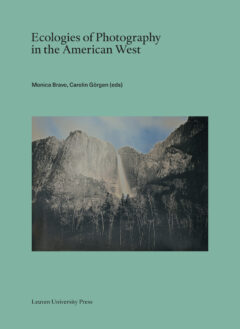 Ecologies of Photography in the American West
Monica Bravo (Editor), Carolin Görgen (Editor),
September 2026