

Liveable Futures
 Liveable Futures provides a platform to articulate the ideals, relations and knowledge we need for liveable futures. The various contributions explore what is essential for political processes, institutions and scientific insights to garner sufficient trust and reliability. They also open up the question of what is crucial to further enable us to care—rather than discover, profit or exploit.
‘Liveable futures’ are put forth as alternative aspirations to sustainability. ‘Liveable’ ranges from likely to survive, to suitable for living in, to pleasant to live in. Such a sliding scale seems appropriate for uncertain times. Liveable is an adjective that provides more depth, more modulation to the possibility of flourishing than a neo-liberal economic focus on growth. ‘Liveable futures’ indicates that the possibility of survival—and therefore also the possibility of NOT living on—has to be taken into careful account. A liveable future is neither a measureable object (like growth), nor a certainty, nor an assessment (like sustainability), but a set of conditions that are good enough to live in.
The series aims to articulate and affect the political, scientific, material and symbolic configurations we use to make our worlds, and to help imagine the kinds of futures we want. It will include works that span one or more of the following fields or disciplines:
- Science and technology studies
- Environmental history
- Anthropology of science/technology/nature
- Environmental humanities
- Social Epistemology
The series welcomes contributions by established scholars as well as by promising young researchers, and embraces diversity in terms of gender, nationality, and ethnicity.
All books are written for an international audience of scholars. All manuscripts are subject to peer review.
Picture: Lone Thomasky & Bits&Bäume / https://betterimagesofai.org / https://creativecommons.org/licenses/by/4.0/
An underwater photo taken looking up to a large circular school of fish while the sun sparkles in the blue water. However, the image is slightly distorted by digital artefacts.
Series editors
– Prof. dr. Anne Beaulieu (Chair), Utrecht University
– Marije Miedema (Editorial Assistant), University of Groningen
– Dr. Stephanie Ketterer, Wageningen University
– Prof. dr. Paul Wouters, Leiden University
– Prof. dr. Nishant Shah, The Chinese University of Hong Kong
– Dr. Edgar Gómez-Cruz, University of Texas
– Dr. Oluwabunmi Bernard, Obafemi Awolowo University
Proposals
Proposals and enquiries can be sent to the series’ chair prof. dr. Anne Beaulieu.
Please make use of the submission form to present your manuscript or proposal to our board.
Authors interested in Open Access can consult the available funding options.
Links & Resources
The first title is expected in Fall 2026.
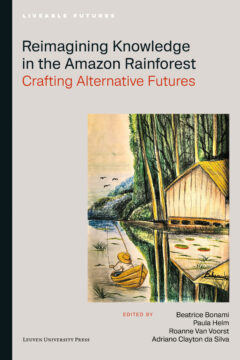 Reimagining Knowledge in the Amazon Rainforest
Beatrice Bonami (Editor), Paula Helm (Editor), Roanne van Voorst (Editor), Adriano Clayton da Silva (Editor),
January 2027
